If you’re shopping a new sedan or compact SUV today (April 2026), the five-year numbers for EVs look very different from what most comparison articles still show. The biggest reason: the Toyota Camry is now hybrid-only, rated at 51 MPG combined, starting at $29,100. A surprising number of EV-vs-gas posts still haven’t incorporated that shift, and it compresses the sedan-side fuel-savings math by nearly 40%. This post runs the ev vs gas total cost of ownership for two current pairs: 2026 Tesla Model 3 Standard vs Toyota Camry LE, and 2026 Chevrolet Equinox EV LT vs Honda CR-V LX AWD. All figures are 2026 MY current-buy.
A Note on the Tax Credit (One Paragraph, Then We Move On)
Through September 30, 2025, buyers of qualifying EVs, including the Model 3 and the Equinox EV, could claim the full $7,500 IRA § 30D clean-vehicle credit. That credit expired nationwide on that date, per the IRS § 30D page and Tesla’s own /IRA landing page (titled “Federal Tax Credit Ends September 30”). If you’re reading an older article that baked the $7,500 into the EV side of the math, subtract it. It’s not available to any buyer today.
What You’re Actually Paying at the Dealer
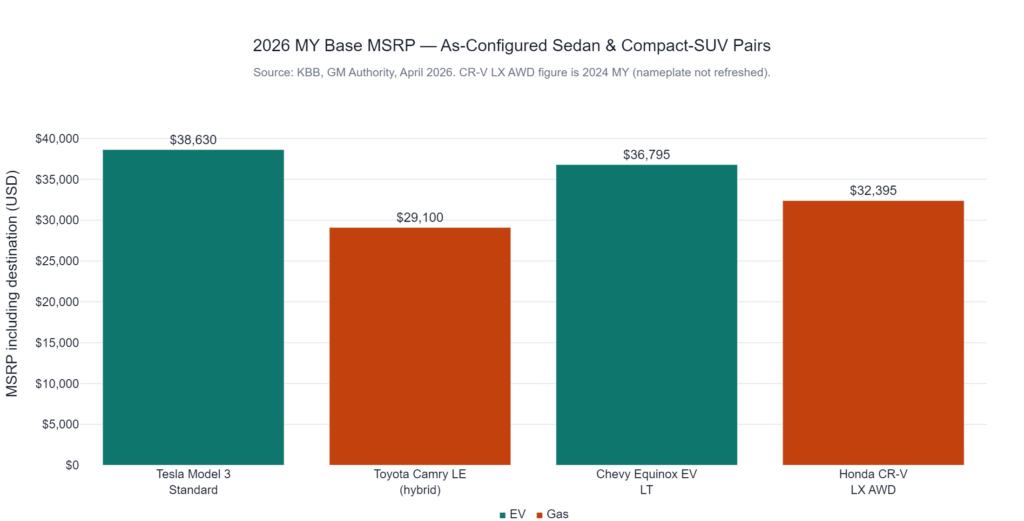
The 2026 MY is what’s on lots right now. Here’s the current sticker reality:
| Vehicle | 2026 MY Base MSRP | Source |
|---|---|---|
| Tesla Model 3 Standard | $38,630 incl. destination | KBB, April 2026 |
| Toyota Camry LE (hybrid-only) | $29,100 | KBB 2026 Camry LE, April 2026 |
| Chevrolet Equinox EV LT base | $36,795 | KBB / GM Authority, April 2026 |
| Honda CR-V LX AWD | ~$32,395 (2024 MY verified; 2026 not refreshed) | KBB |
For the record: Toyota made the Camry hybrid-only for the 2025 model year and continues hybrid-only for 2026. There is no non-hybrid Camry trim for sale in the US. Any comparison that benchmarks an EV against a “non-hybrid Camry” at 32 MPG is working from a product line that Toyota doesn’t sell anymore.
The sedan purchase gap: $9,530 (Model 3 over Camry LE). The SUV gap: roughly $4,400 (Equinox EV over CR-V). Those deltas are the hole each EV has to dig out of over five years.
EPA Efficiency: What the Sticker Actually Says
Correcting the record on a figure you’ll still see cited from older model-year data:
Tesla Model 3 Standard (2026 MY): 321 miles EPA range, ~24 kWh/100 mi (~4.17 mi/kWh), 139 MPGe city for the base RWD trim. Sources: InsideEVs reporting on EPA-certified data and Edmunds’ real-world range test (which actually clocked 339 miles). Note that fueleconomy.gov’s public search tool still surfaces older MY entries for the Model 3; the 2026 Standard deep-link wasn’t confirmed in a direct EPA URL, but the figures above are EPA-certified per InsideEVs.
Chevrolet Equinox EV LT FWD (2026 MY): 319 miles EPA range, 31 kWh/100 mi (~3.23 mi/kWh), 108 combined MPGe. Listed directly on fueleconomy.gov’s 2026 Chevrolet Equinox EV FWD entry. The Equinox EV is notably less efficient per mile than the Model 3. That matters when you’re running electricity-cost projections.
Toyota Camry LE (2026 MY, hybrid, FWD): 53 city / 50 highway / 51 combined MPG, per Edmunds citing fueleconomy.gov. Honda CR-V LX AWD (1.5T, CVT): 27 / 32 / 29 combined MPG, fueleconomy.gov ID 46716.
The manufacturer claims 321 miles on the Model 3. The data (Edmunds’ instrumented test) shows 339. Real-world figures on the gas side tend to run 10-15% below sticker, per Consumer Reports methodology. The relative rankings hold even after that haircut, but don’t plan a road-trip budget off the EPA number alone.
Five-Year Fuel and Maintenance Costs
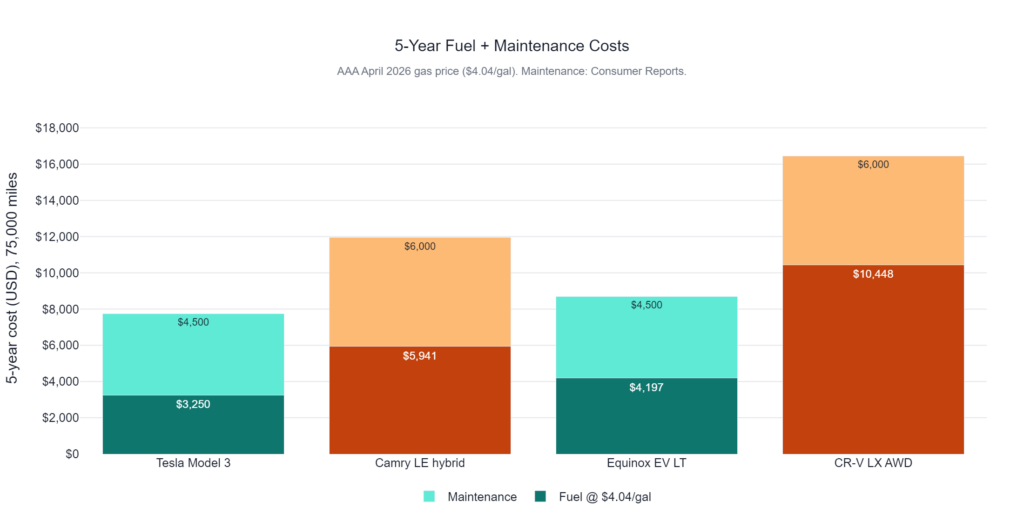
National averages as of April 2026: $0.1805/kWh residential electricity (EIA / Choose Energy); $4.04/gal regular gasoline (AAA, April 21, 2026). That gas figure is elevated due to the 2026 Iran war fuel crisis and the April 18, 2026 closure of the Strait of Hormuz by Iran (citing US blockade of Iranian ports). The IEA has characterized the disruption as the largest in global oil-market history. Sources: AAA newsroom April 2026, Washington Post April 18, 2026. The situation is fluid; gas prices may or may not stay here. The table below shows both the current and a more stable scenario.
Baseline: 15,000 miles per year, 75,000 miles over five years.
| Model 3 Standard | Camry LE (hybrid) | Equinox EV LT | CR-V LX AWD | |
|---|---|---|---|---|
| EPA efficiency | 24 kWh/100 mi | 51 MPG combined | 31 kWh/100 mi | 29 MPG combined |
| 5-yr fuel @ $4.04/gal | ~$3,250 | ~$5,941 | ~$4,197 | ~$10,448 |
| 5-yr fuel @ $3.50/gal | ~$3,250 | ~$5,147 | ~$4,197 | ~$9,052 |
| 5-yr maintenance | ~$4,500 | ~$6,000 | ~$4,500 | ~$6,000 |
Maintenance figures come from Consumer Reports: EVs average ~$900/yr versus ~$1,200/yr for gas vehicles, with lifetime EV savings around $4,600.
Here’s where the sedan math shifts dramatically versus older comparisons. At current gas prices, the Model 3’s fuel advantage over the hybrid Camry is only about $2,691 over five years, not the $6,000+ figure that older posts (running the Camry at 32 MPG non-hybrid) tend to cite. At $3.50/gal it’s $1,897. The 51-MPG hybrid drivetrain is quietly doing most of the work that the § 30D credit used to do on the EV side.
The SUV pair still shows a real gap: about $6,250 at current gas prices, or $4,855 at $3.50/gal. The CR-V at 29 combined MPG doesn’t have a hybrid-only bailout to tighten the fuel math.
Depreciation: The Part the EV Ads Don’t Mention
Five-year ownership math doesn’t work without depreciation, and this is where the EV value argument gets complicated.
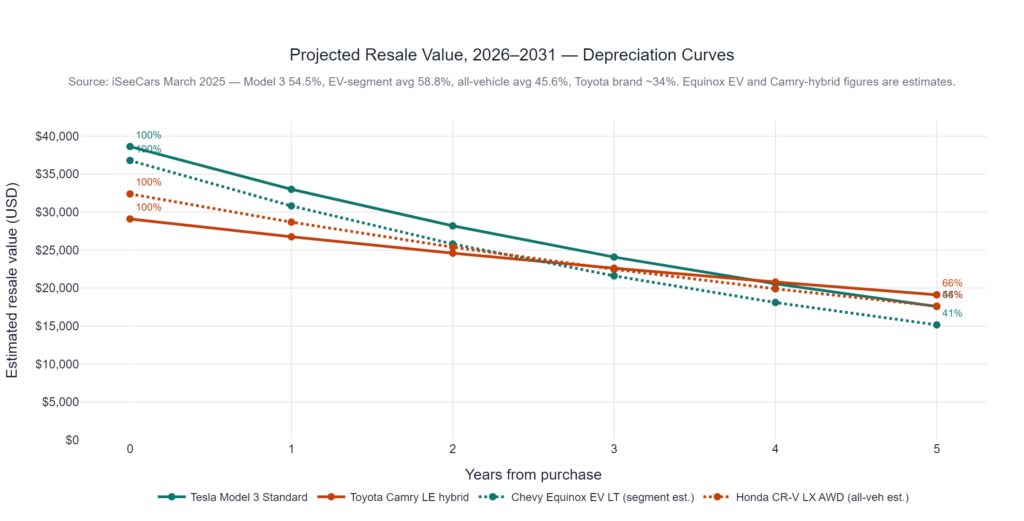
Per iSeeCars March 2025 data: EVs depreciate an average of 58.8% over five years, compared to 45.6% for all vehicles industry-wide. The Model 3 beats the EV segment average: 54.5% five-year depreciation, which on a $38,630 purchase implies a loss of roughly $21,053 in resale value. The Camry nameplate’s iSeeCars figure is 34.3%, but that’s trailing data from the non-hybrid era. With the Camry now hybrid-only, a more defensible estimate is Toyota-brand-wide retention, which tracks around 34%. Applied to a $29,100 hybrid Camry LE, that’s roughly $9,894 in value lost. Hybrid Camrys may hold value slightly better than the nameplate’s historical average, but we don’t have five years of hybrid-only Camry resale data yet, so treat this as an estimate, not a verified figure.
Depreciation delta on the sedan pair: about $11,159 more loss on the Model 3 over five years.
For the SUV pair: iSeeCars didn’t return a specific Equinox EV figure in the research used here. Using the EV industry average of 58.8% on $36,795 projects roughly $21,635 in value lost, explicitly an estimate, not a model-specific number. The CR-V doesn’t have a verified iSeeCars figure in this pass either; using the all-vehicle average of 45.6% on $32,395 projects roughly $14,772 in value lost. Difference: approximately $6,863 more depreciation on the Equinox EV. That gap could be smaller or larger depending on how EV resale values move over the next few years, which is a genuine unknown.
Heavy depreciation is the friction point in every EV TCO argument. Fuel savings of $2,000 to $6,000 over five years don’t erase a $10,000+ depreciation disadvantage. The math works if you hold the vehicle long enough. Five years often isn’t long enough.
Insurance: The $6,675 Line Item Nobody Budgets For
Per Insurify’s 2025 report, confirmed by Bankrate: EVs average $4,058 per year for full coverage, 49% higher than comparable gas vehicles. That implies a gas-vehicle baseline of roughly $2,723/yr.
Over five years, that gap is $6,675. Not a rounding error. The cheapest EVs to insure per Insurify are the Chevrolet Silverado EV ($1,947/yr) and the Nissan Leaf ($2,683/yr). Model-specific figures for the Model 3 Standard and Equinox EV LT weren’t captured in the sources used here; the $4,058 is the EV category average. The Model 3 premium likely runs above that average given repair-parts costs. The Equinox EV is probably closer to it.
Any TCO comparison that folds insurance into a footnote or leaves it out entirely is doing the EV a favor it hasn’t earned.
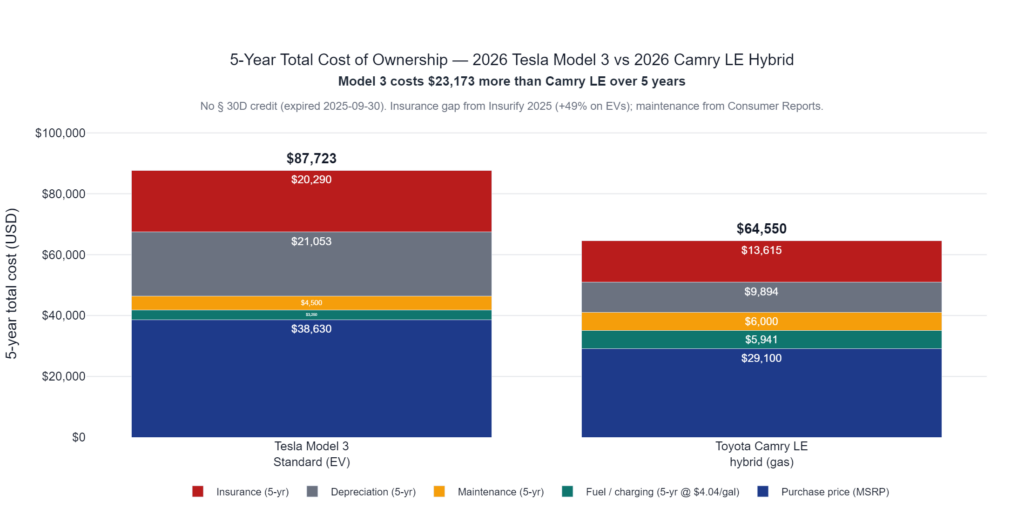
TL;DR: Five-Year TCO Snapshot (2026 MY, No Credit)
| Cost category | Model 3 Standard | Camry LE (hybrid) | Equinox EV LT | CR-V LX AWD |
|---|---|---|---|---|
| Purchase price | $38,630 | $29,100 | $36,795 | ~$32,395 † |
| § 30D credit | Not available | — | Not available | — |
| 5-yr fuel @ $4.04 | ~$3,250 | ~$5,941 | ~$4,197 | ~$10,448 |
| 5-yr fuel @ $3.50 | ~$3,250 | ~$5,147 | ~$4,197 | ~$9,052 |
| 5-yr maintenance | ~$4,500 | ~$6,000 | ~$4,500 | ~$6,000 |
| 5-yr depreciation | ~$21,053 | ~$9,894 est. | ~$21,635 est. | ~$14,772 est. |
| 5-yr insurance avg | ~$20,290 (+49%) | ~$13,615 | ~$20,290 (+49%) | ~$13,615 |
† CR-V 2026 MY pricing not separately verified in this research pass; 2024 MY figure used as a reasonable approximation for a non-refreshed nameplate.
Sedan pair: The Model 3 costs $9,530 more to buy, depreciates about $11,159 more over five years, and carries a 49%-higher insurance premium. The fuel and maintenance savings of $2,000 to $2,700 over five years, depending on gas prices, don’t come close to closing the gap on their own at the five-year mark. The Camry’s hybrid-only transition matters here: it’s the gas side’s single biggest improvement to TCO math in years. Break-even for the EV requires a longer ownership horizon or gas prices staying well above $4.
SUV pair: The picture is closer, because the CR-V doesn’t have a hybrid-only equivalent to the Camry’s. The Equinox EV LT costs ~$4,400 more upfront, and the estimated depreciation gap is roughly $6,900. Fuel savings of $4,900 to $6,250 over five years are competitive with that spread. At current elevated gas prices, the Equinox EV’s case is stronger. At $3.50/gal it weakens.
Neither EV is a clear five-year winner without the § 30D credit at current depreciation rates. That’s not an argument against buying one. It’s an argument for being realistic about the timeline.
For the Record
The fuel and maintenance savings are documented. The insurance and depreciation disadvantages are documented. The Camry’s hybrid-only transition is documented, and it reshapes the sedan comparison more than any other single input. Anyone selling you on a five-year EV payoff without running all four cost categories against a current-MY hybrid competitor is working from an incomplete model.
Sources used here: EPA (fueleconomy.gov for Equinox EV; InsideEVs/Edmunds for 2026 Model 3 Standard pending fueleconomy.gov’s 2026 Model 3 listing), iSeeCars March 2025, Consumer Reports, Insurify 2025, EIA April 2026, AAA April 21, 2026, KBB, Edmunds, Cars.com, Washington Post, and the IRS § 30D page, all as of April 24, 2026. Gas prices remain an active variable tied to the Iran war fuel crisis. If they drop back toward $3.00 to $3.50, the EV fuel savings shrink and the depreciation gap matters more. What’s your actual plan for how long you’ll own it? That number changes the answer more than the gas price does.