The Section 30C federal tax credit (30% of your total installed cost, up to $1,000) expires June 30, 2026. That’s 34 days from today. Most buyers don’t know their address may not qualify even if they order tomorrow. This post covers the five Level 2 home chargers that earned cross-source consensus in 2026 roundups, the amperage math most guides skip, the real installation cost range, and why one former staple recommendation is now off the list entirely. Buy with the facts, not the marketing copy.
The Tax-Credit Clock Is Running
The Section 30C Alternative Fuel Vehicle Refueling Property Credit pays 30% of your total installed cost (charger hardware plus labor), up to $1,000 per charging port. The One Big Beautiful Bill Act truncated the original 2032 sunset down to June 30, 2026. Install and place it in service by that date or the credit doesn’t exist for you. There’s no extension legislation pending as of May 2026, per the Electrification Coalition’s analysis of the bill.
Here’s what most write-ups bury: location eligibility. The credit only applies if the charger is installed in a qualifying low-income community census tract OR a non-urban (rural) census tract. Many suburban homeowners in standard residential tracts don’t qualify at all. Before you order a single unit, verify your address using the IRS census tract tool. Claim it on IRS Form 8911 filed with your federal return for the year installation was completed.
The deadline is June 30, 2026. If you’re reading this anywhere near that date, run the census-tract check today, not after you’ve bought the hardware.
What Power Level You Actually Need
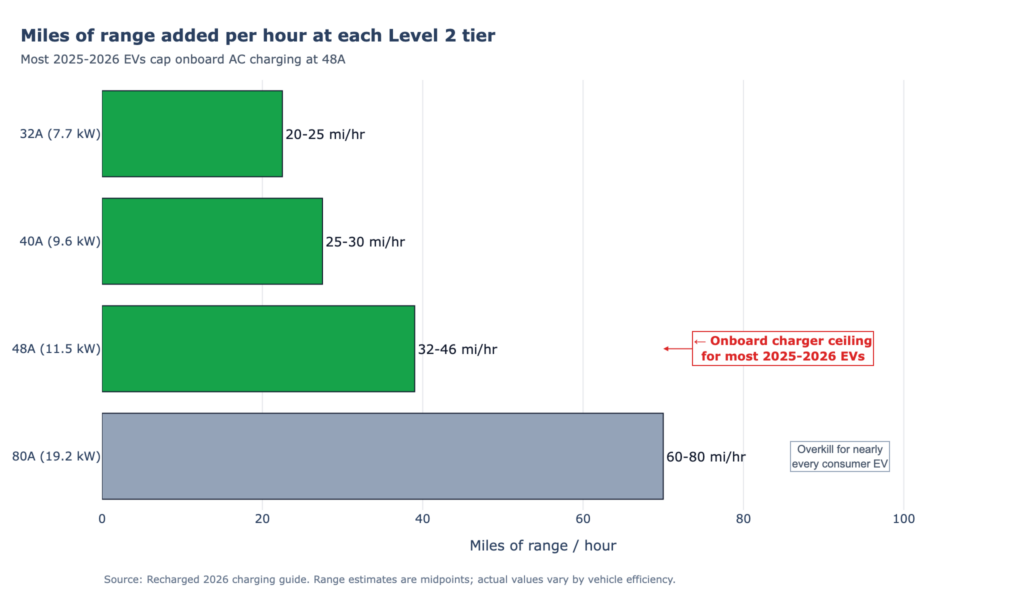
Four amperage tiers get sold as home Level 2 chargers. Here’s what each one actually does, per Recharged’s charging guide verified May 2026:
- 32A (7.7 kW): Roughly 20-25 miles of range added per hour. Fine for plug-in hybrids and low-mileage commuters who plug in every night.
- 40A (9.6 kW): The most common plug-in configuration, typically via NEMA 14-50 outlet. Adds approximately 25-30 miles per hour. Requires a 50A breaker.
- 48A (11.5 kW): The ceiling most 2025-2026 EVs can accept on AC Level 2. Adds approximately 32-46 miles per hour. Requires a 60A breaker. This is where most buyers should stop.
- 80A (19.2 kW): Frequently pitched as “future-proof,” but as of May 2026, virtually no mainstream consumer EV accepts more than 48A on Level 2 AC charging. You’d be paying for headroom your car can’t use today, and DC fast charging is the path manufacturers are taking for higher speeds anyway.
The 5 Picks
| Model | Price (May 2026) | Max Amps | Output | Connector | Certifications | Warranty |
|---|---|---|---|---|---|---|
| ChargePoint Home Flex | $549 | 50A hardwired | 12 kW | J1772 or NACS | UL / ENERGY STAR / NEMA 4 | n/a |
| Emporia Classic | $429 | 48A hardwired | 11.5 kW | J1772 or NACS | UL / ENERGY STAR | n/a |
| Wallbox Pulsar Plus | $749.99 ($614.99 sale) | 48A hardwired | 11.5 kW | J1772 or NACS | UL / ENERGY STAR / NEMA 4 | n/a |
| Grizzl-E Classic Connect 40A | $349.99 | 40A | 9.6 kW | J1772 or NACS | UL / ENERGY STAR / NEMA 4 / IP67 | n/a |
| Tesla Universal Wall Connector | $550 | 48A hardwired | 11.5 kW | NACS + J1772 | UL / ENERGY STAR / NEMA 3R | 4 years |
Best Overall: ChargePoint Home Flex
$549 MSRP as of 2026-05-15 (ChargePoint Store, NEMA 14-50 plug-in version)
The ChargePoint Home Flex holds the top or second spot in every 2026 roundup worth citing: EnergySage, Recharged, DriveAuthority, Electric Cascades, simpleswitch.io. Up to 50A hardwired, 12 kW output, UL Listed, ENERGY STAR certified, NEMA 4 rated for outdoor use. The app handles scheduling, energy monitoring, and time-of-use rate management. It integrates with ChargePoint’s public network, so your charging history and account are unified whether you’re at home or on the road.
Available in both J1772 and NACS connector variants, which matters now that most 2025 model year vehicles ship NACS-native per SAE J3400 adoption. ChargePoint lists the two connector variants as separate SKUs with their own pricing — confirm the listed price for the version you want before ordering.
One caveat that belongs upfront, not in footnotes: active forum reports from 2025-2026 document charging failures with certain 2025 NACS-native vehicles, specifically some 2025 IONIQ 5 units, some Equinox EVs, and at least one Polestar 3. The failure mode (“charging not completed within 30 seconds”) appears to be firmware or protocol compatibility, not a hardware defect. Long-term J1772 users report no issues over three-plus years. If you own a 2025 NACS-native vehicle, check ChargePoint’s firmware release notes before purchasing the NACS variant. Known issue, not a disqualifying one.
Best Value: Emporia Classic
$429 MSRP as of 2026-05-15 (Emporia Energy Shop; Pro version $599)
At $429 for the Classic and $599 for the Pro with PowerSmart load management, Emporia delivers meaningful specs without padding the price. Up to 48A hardwired (40A via NEMA 14-50), available in J1772 or NACS, UL Listed, ENERGY STAR certified. The app supports energy monitoring, solar integration with Emporia’s Home Energy Monitor ecosystem, and time-of-use scheduling. State of Charge’s Tom Moloughney flagged it as a best budget pick across multiple 2026 comparisons, and Electrek’s hands-on test of the Pro from June 2025 found no dealbreakers.
The upgrade path is worth knowing. If your electrical panel is already near capacity, the Pro’s PowerSmart technology dynamically limits charge current to potentially avoid a panel upgrade that would otherwise run $1,500-$3,000. The math on the $170 Pro premium works in your favor fast if you’re borderline on panel capacity.
No significant reliability complaints surfaced in 2025-2026 searches. No systematic issues documented.
Best Smart Features / Power Sharing: Wallbox Pulsar Plus
$749.99 regular / $614.99 sale as of March 2026 (Wallbox Shop, NACS 48A version)
The Pulsar Plus earns its spot on one feature no other charger in this price tier matches cleanly: dynamic load balancing and power sharing between two units on a single circuit. If you’ve got two EVs and don’t want to rewire the garage for independent 60A circuits, this is the documented solution. Up to 48A, UL Listed, ENERGY STAR, NEMA 4 rated, Wi-Fi plus Bluetooth, and OCPP 1.6J support for home and business setups.
That OCPP support needs a caveat for anyone running evcc or Home Assistant. The integration community has documented synchronization issues with third-party OCPP setups. Wallbox released a firmware update in October 2025 addressing a specific OCPP reconnection bug, but the evcc GitHub discussion thread shows this is still an active area of attention. If you’re building a whole-home energy management system, verify the current firmware state before committing.
At $749.99 regular price, it’s the most expensive pick here. The $614.99 sale pricing from March 2026 is real but not guaranteed to persist. Wallbox’s direct shop has shown the NACS 48A SKU sold out in May 2026 — check Amazon if the direct path is dry.
Best Outdoor / No-Frills Durability: Grizzl-E Classic Connect 40A
$349.99 MSRP as of 2026-05-15 (Amazon, NACS version)
For the record: the original Grizzl-E Classic (the dumb, no-Wi-Fi workhorse with 4.6 stars across 3,500-plus Amazon reviews) is being discontinued by United Chargers. The current-buy model is the Classic Connect 40A, which adds Wi-Fi and app connectivity while keeping the metal aluminum enclosure, NEMA 4 rating, IP67 protection, and operating range from -22°F to +122°F. NACS option available. UL Listed, ENERGY STAR certified.
InsideEVs rated it top pick for outdoor durability, and owner reports of two-plus years of flawless operation in harsh climates are numerous and consistent. At $349.99, it’s the lowest price on this list.
The trade-off is speed. The Classic Connect 40A caps at 40A / 9.6 kW. If you want to charge a 100 kWh battery as fast as Level 2 allows, you’d leave roughly 20 minutes on the table versus a 48A unit. For most owners who plug in overnight, that’s irrelevant. For high-usage households where every charging hour counts, worth knowing.
Best NACS-Native / Mixed Households: Tesla Universal Wall Connector
$550 on Amazon as of 2026-05-14 (per 9to5toys report; price is volatile, verify before ordering)
The Tesla Universal Wall Connector doesn’t require an adapter for any North American EV. Dual NACS plus J1772 integrated connector. Up to 48A / 11.5 kW. UL Listed, ENERGY STAR certified, NEMA 3R rated for outdoor use. Wi-Fi, Tesla app integration, scheduling, energy monitoring, power sharing among up to six units on one circuit. Four-year warranty, the best coverage on this list.
If you have a mixed household (one Tesla, one non-Tesla EV), this is the documented solution. One unit, two standards, no adapter shelf required. The SAE J3400 framework that formalized NACS in September 2024 is the foundation this product sits on.
One note on pricing: the $550 Amazon figure is a recent drop reported by 9to5toys on May 14, 2026. Tesla’s own shop lists the Gen 3 Wall Connector (NACS-only, Tesla vehicles) separately at $425. These are different products. Verify current pricing before ordering.
Installation Cost: What You’ll Actually Pay
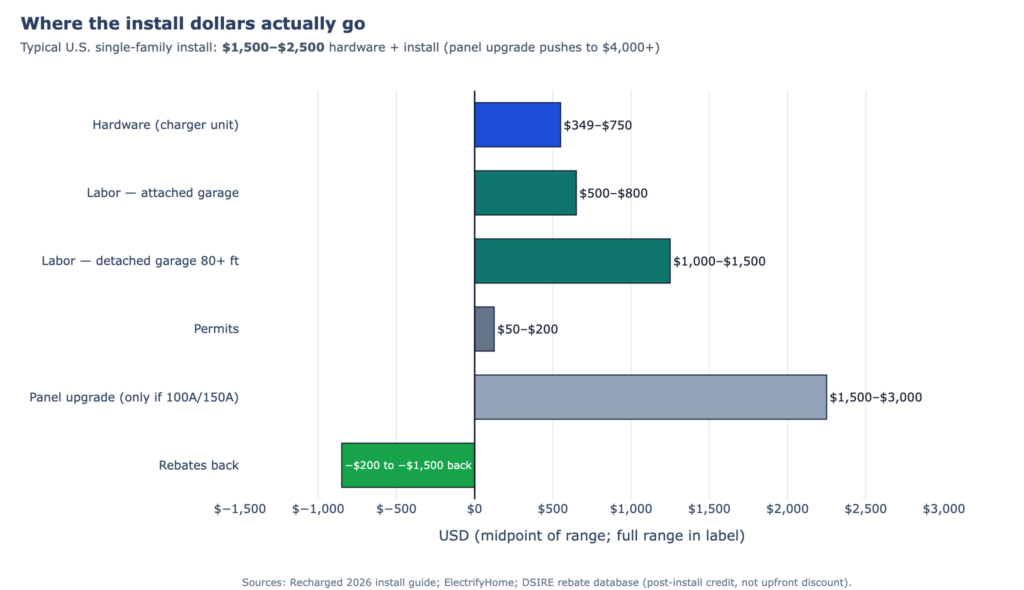
The charger hardware is only part of the bill. Per Recharged’s 2026 installation cost guide and ElectrifyHome’s estimates, typical total (charger plus install) runs $1,500-$2,500 for U.S. single-family homes with adequate panel capacity.
Labor runs $500-$800 for an attached garage near the panel, or $1,000-$1,500 for a detached garage 80-plus feet away (permits at $50-$200 are required in virtually all U.S. jurisdictions). Older 100A or 150A panels add $1,500-$3,000 for a service upgrade, pushing total cost to $4,000-plus, which is exactly where the Emporia Pro’s load management pays off.
State and utility rebates ($200-$1,500 range) are tracked at dsireusa.org. Filter by Technology → Electric Vehicles → Charging Equipment for your state’s current programs.
Correcting the Record on JuiceBox
JuiceBox was a legitimate recommendation for years. Enel X Way North America shut down October 11, 2024. The hardware still pushes electrons, but all smart charging features, app functionality, and warranty support are gone. If you see a JuiceBox on any “best of 2026” list that isn’t framed in past tense, that list didn’t update its sources. This is documented.
Don’t buy one.
The Verdict
By buyer type, here’s where the five picks land:
If you have a 2025-plus NACS-native EV in a mixed household: Tesla Universal Wall Connector at $550. Two standards, one unit, four-year warranty.
If price is the primary constraint: Grizzl-E Classic Connect at $349.99. Metal case, IP67, proven track record. You give up 8A versus the 48A ceiling, which won’t matter if you charge overnight.
If you’re managing two EVs on one circuit: Wallbox Pulsar Plus. Dynamic load balancing is the only documented solution in this price range. Budget for the firmware caveat if you run Home Assistant.
If you want the broadest network integration and a mature app: ChargePoint Home Flex at $549. Check firmware notes first if your vehicle is a 2025 NACS-native model.
If you want 48A capability at the lowest price: Emporia Classic at $429.
Before you finalize any order: verify your address at the IRS census tract tool. The 30C credit deadline is June 30, 2026. That’s up to $1,000 back on installation costs, gone in 34 days. If your address qualifies, this is the week to act.
What’s slowing you down: the install cost estimate, the panel situation, or the connector standard question?